Check out our most popular compounded medications! Get Started




Licensed to fill prescriptions for patients in RI, MA, CT, NJ, NH, FL, ME and PA. New York patients are served on a limited basis while nonresident registration is pending.
Prepared to a prescriber's order for one patient. Not FDA-approved.
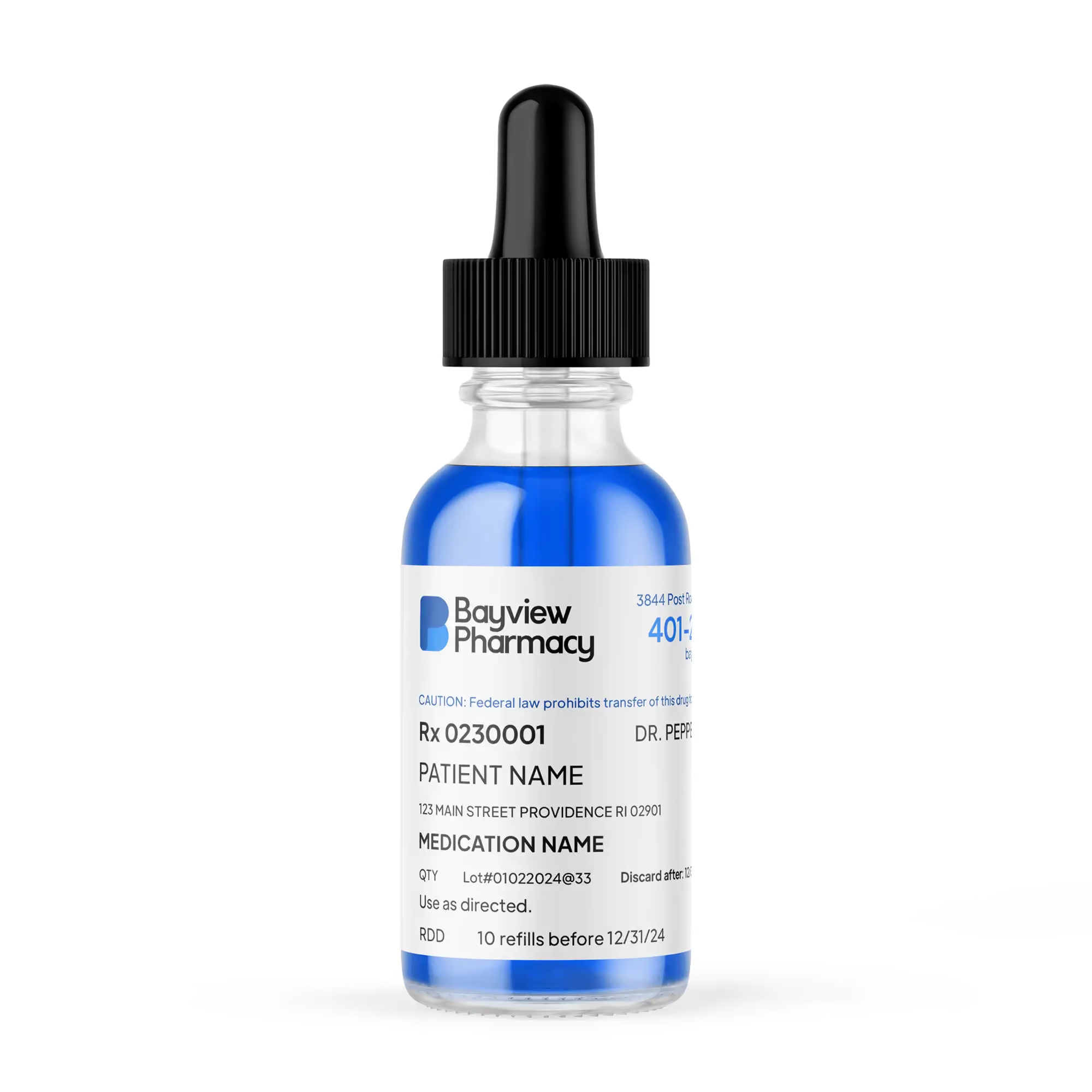
This is a compounded sublingual solution containing propranolol hydrochloride, prepared to a prescriber's order for one patient. Compounded preparations are not FDA-approved.
These listings cover every salt or ester form of each drug in the FDA National Drug Code Directory.
FDA-approved products containing propranolol are listed in solution, tablet, capsule and injection forms.
Liquid bases can be aqueous or nonaqueous, and USP <795> classifies the preparation by its water activity. Aqueous preparations carry shorter default beyond-use dates than nonaqueous ones. The date printed on the label is the one to follow.
Propranolol is a nonselective beta-blocker that compounding pharmacies prepare as oral liquids, capsules and topical creams or gels by prescription.
Propranolol is a beta-blocker. It blocks both beta-1 and beta-2 adrenergic receptors, which slows the heart rate, lowers the force of each heartbeat and blunts the body's response to adrenaline. Manufactured forms include tablets, extended-release capsules, an oral solution and an injection. Inderal LA extended-release capsules are FDA-approved for high blood pressure, angina from coronary artery disease, prevention of common migraine and hypertrophic subaortic stenosis. Hemangeol oral solution is approved for proliferating infantile hemangioma requiring systemic therapy. No manufactured topical form of propranolol exists, so a prescriber may order it compounded as a cream or gel, or as an oral liquid or capsule in a strength or vehicle not made commercially. Compounded preparations are not FDA-approved and require a prescription.
Propranolol does not carry a boxed warning, but the label warns that stopping it suddenly has led to worsening angina and, in some cases, heart attack, so do not stop it suddenly. Do not use propranolol if you have cardiogenic shock, a very slow heart rate or heart block beyond first degree without a pacemaker, bronchial asthma, or an allergy to propranolol. It can mask signs of low blood sugar and an overactive thyroid, may worsen heart failure, and can make epinephrine less able to treat a severe allergic reaction. Drugs that block CYP2D6, CYP1A2 or CYP2C19 can raise propranolol levels, and warfarin needs closer monitoring. Newborns exposed near delivery may have a slow heart rate, low blood sugar or breathing problems. Propranolol passes into breast milk in small amounts, and LactMed says no special precautions are required. For dizziness, fatigue or breathing trouble, talk to your prescriber or pharmacist.
Propranolol is a nonselective, competitive beta-adrenergic antagonist and class II antiarrhythmic with membrane-stabilizing activity. It is highly lipid soluble and crosses the blood-brain barrier and placenta. Oral absorption is nearly complete, but extensive first-pass hepatic metabolism leaves systemic bioavailability around 20 to 30 percent; about 90 percent is bound to albumin and alpha-1-acid glycoprotein. It is metabolized mainly by CYP2D6 and CYP1A2, with a lesser CYP2C19 role, and is a P-glycoprotein substrate. Half-life is about 3 to 6 hours for immediate-release forms and about 10 hours for Inderal LA. Labeled indications include hypertension, angina, migraine prophylaxis and hypertrophic subaortic stenosis (Inderal LA) and proliferating infantile hemangioma (Hemangeol). Prescribers have ordered compounded topical propranolol for superficial infantile hemangioma; a 2025 formulation study notes no commercial topical product exists, so pharmacies prepare it extemporaneously. Dosing per prescriber. Monitor heart rate, blood pressure and glucose in patients with diabetes, and taper rather than stop abruptly. Propranolol is not a controlled substance.
Draw up the dose with the oral syringe or dropper provided. Squirt or drop it under your tongue and hold it there without swallowing for the time on your label. Swallow afterward. Avoid eating or drinking for about 30 minutes after the dose unless your pharmacist says otherwise.
Sublingual solutions are aqueous. Under USP <795>, a preserved solution usually carries a beyond-use date of up to 35 days at room temperature or refrigerated, and an unpreserved one 14 days refrigerated. Your label shows whether to refrigerate and the beyond-use date. Keep out of reach of children and discard after that date.

This formulation is compounded by Bayview Pharmacy on a prescriber's order for an individual patient. It is not an FDA-approved drug product, and the FDA has not evaluated it for safety, effectiveness, or manufacturing quality.
A valid prescription is required. Availability depends on Bayview's licensure in your state. This page is general information, not medical advice. Discuss your situation with a licensed healthcare provider.
Search by NCPDP 4106882, or by name and ZIP: Bayview Pharmacy, Warwick, RI 02886. Select it as the destination pharmacy and save it as a favorite. Click any value to copy it.
Compounded preparations have no NDC, so this formula will not appear in your EHR's drug search. Use your system's compound, non-formulary, or free-text prescription entry and name the preparation exactly as written in step 3. If your EHR forces you to pick a listed drug, pick the closest entry for the active ingredient and put the full formula in the prescription body (the Sig or directions field), not in Notes to Pharmacy.
Compounded preparations have no NDC and will not appear in your drug search. For EPCS to validate, select a drug entry your EHR recognizes as controlled, usually the bulk powder entry for the active ingredient (for example Ketamine (bulk) powder, not a branded product), then put the full formula from step 3 in the prescription body. A free-text entry that does not validate as controlled will be rejected by your EPCS module.
Quantity and directions are starting points for this dose form, not treatment recommendations. Dosing remains the prescriber's responsibility.
Transmit from your EHR. For this non-controlled preparation we also accept fax to (401) 284-4506 and phoned orders at (401) 284-4505. Order forms are on the formulation pages and in the prescriber portal.
Transmit with two-factor authentication through your EPCS-enabled EHR. No order form is offered for this preparation; e-prescribing guides for our controlled preparations are on the formulation pages.
Licensed to dispense in RI, MA, CT, NJ, NH, FL, ME, and PA; New York is served on a limited basis while nonresident registration is pending. Compounded preparations are not FDA-approved. A valid prescription is required. Full guide, including steps by EHR: How to e-prescribe to Bayview. Questions about this formula: call (401) 284-4505.
Place dropper amount under the tongue

