Check out our most popular compounded medications! Get Started




Licensed to fill prescriptions for patients in RI, MA, CT, NJ, NH, FL, ME and PA. New York patients are served on a limited basis while nonresident registration is pending.
Prepared to a prescriber's order for one patient. Not FDA-approved.
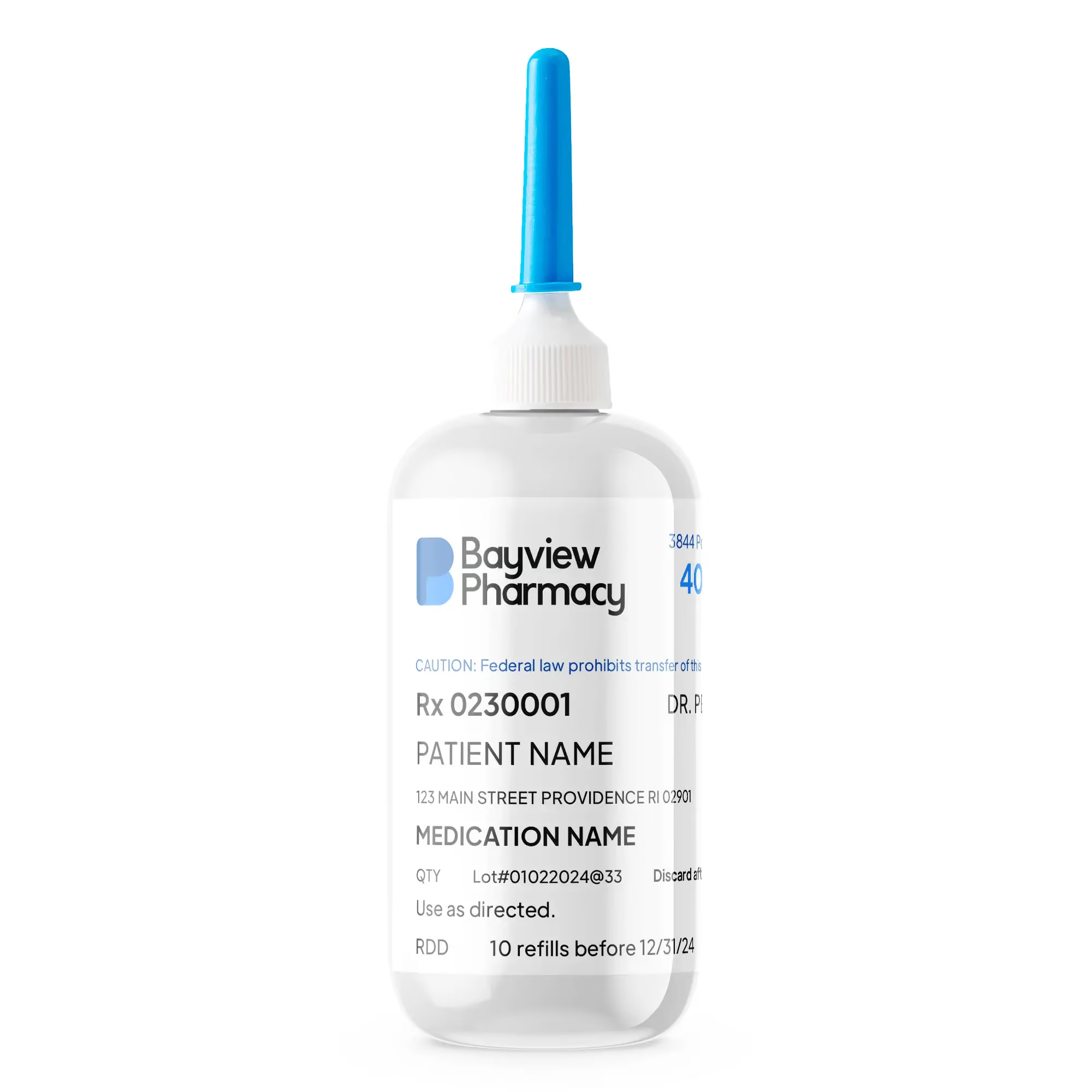
This is a compounded enema containing chlorpromazine hydrochloride, prepared to a prescriber's order for one patient. Compounded preparations are not FDA-approved.
These listings cover every salt or ester form of each drug in the FDA National Drug Code Directory.
FDA-approved products containing chlorpromazine are listed in tablet, injection and concentrate forms. No finished chlorpromazine product of any kind is listed in enema form. None of the FDA-approved chlorpromazine products is for rectal use.
This dose form is water-containing (aqueous). Under USP <795>, aqueous preparations carry shorter default beyond-use dates than nonaqueous ones, and a preservative in the base allows a longer date than no preservative. The date printed on the label is the one to follow.
Chlorpromazine hydrochloride is a first-generation (phenothiazine) antipsychotic, taken by mouth or injected, that a pharmacy may compound when a prescriber orders it.
Chlorpromazine is a phenothiazine antipsychotic, one of the first-generation (typical) antipsychotics. Its exact mechanism is not known; StatPearls describes blockade of dopamine D2 receptors for its antipsychotic effect and combined blockade of dopamine, histamine and muscarinic receptors in the vomiting center for its anti-nausea effect. It also has sedating, antiadrenergic and weaker anticholinergic actions. Manufactured products include generic chlorpromazine hydrochloride tablets, an oral concentrate and an injection, all approved as generics (ANDA). The tablet label lists psychotic disorders and schizophrenia, nausea and vomiting, restlessness before surgery, acute intermittent porphyria, add-on treatment of tetanus, mania, intractable hiccups, and severe behavioral problems or short-term hyperactivity with conduct disorders in children 1 to 12 years. A prescriber might order chlorpromazine compounded in a strength or form that is not manufactured, or without a particular dye or excipient. Compounded preparations are not FDA-approved and require a prescription.
Chlorpromazine labels carry a boxed warning: older adults with dementia-related psychosis who take antipsychotics have an increased risk of death, and chlorpromazine is not approved for that use. Do not use it if you are allergic to phenothiazines, or when comatose or heavily sedated by alcohol, barbiturates or opioids. Label warnings include tardive dyskinesia (possibly permanent involuntary movements), neuroleptic malignant syndrome (fever, stiff muscles, confusion), low white blood cell counts, drowsiness, falls and low blood pressure on standing, trouble cooling down in extreme heat, and the need for caution if you have glaucoma. It adds to the effects of alcohol, sedatives, anesthetics and opioids; may reduce the effect of oral anticoagulants and guanethidine; can raise phenytoin and propranolol levels; and can lower the seizure threshold. Use in late pregnancy can cause movement and withdrawal symptoms in newborns. LactMed says some breastfed infants become drowsy and advises monitoring; the label says to choose between nursing and the drug. Do not stop suddenly. Talk to your prescriber or pharmacist about side effects.
Chlorpromazine is a low-potency phenothiazine with D2 antagonism plus antiadrenergic, anticholinergic, antihistaminic and slight antiserotonergic activity (label; StatPearls). StatPearls describes extensive hepatic metabolism (CYP1A2 and CYP2D6, and a CYP3A4 substrate), high lipid solubility with storage in fat, excretion in urine and bile, and a parent half-life of about 23 to 37 hours with an active metabolite. Labeled indications (chlorpromazine hydrochloride tablets, ANDA): psychotic disorders, schizophrenia, nausea and vomiting, preoperative apprehension, acute intermittent porphyria, adjunct in tetanus, mania, intractable hiccups, and specified severe behavioral problems in children 1 to 12 years. StatPearls lists adjunctive treatment of serotonin syndrome and migraine-associated nausea and vomiting as off-label; these are not FDA-approved indications. Use caution in cardiovascular, liver, renal and chronic respiratory disease, and in prior hepatic encephalopathy. Monitor CBC frequently in the first months when baseline WBC is low or there is a history of drug-induced neutropenia, and stop for severe neutropenia. StatPearls notes QT prolongation, cholestatic jaundice, corneal and lens deposits and hyperprolactinemia. Stop at least 48 hours before metrizamide myelography. False-positive PKU tests can occur. Chlorpromazine is not a controlled substance. Dosing is per prescriber, with periodic reassessment of long-term therapy.
Empty your bowel first if you can. Shake the bottle well. Lie on your left side with your left leg straight and right knee bent. Gently insert the lubricated tip, aim it slightly toward your navel, and squeeze slowly. Stay lying down and hold the liquid for as long as your label directs, often 30 minutes or more; bedtime use is common. Wash your hands before and after.
Enemas are aqueous. Under USP <795>, a preserved enema usually carries a beyond-use date of up to 35 days at room temperature or refrigerated, and an unpreserved one 14 days refrigerated. Keep from freezing, keep out of reach of children, and discard after the beyond-use date on your label.

This formulation is compounded by Bayview Pharmacy on a prescriber's order for an individual patient. It is not an FDA-approved drug product, and the FDA has not evaluated it for safety, effectiveness, or manufacturing quality.
A valid prescription is required. Availability depends on Bayview's licensure in your state. This page is general information, not medical advice. Discuss your situation with a licensed healthcare provider.
Search by NCPDP 4106882, or by name and ZIP: Bayview Pharmacy, Warwick, RI 02886. Select it as the destination pharmacy and save it as a favorite. Click any value to copy it.
Compounded preparations have no NDC, so this formula will not appear in your EHR's drug search. Use your system's compound, non-formulary, or free-text prescription entry and name the preparation exactly as written in step 3. If your EHR forces you to pick a listed drug, pick the closest entry for the active ingredient and put the full formula in the prescription body (the Sig or directions field), not in Notes to Pharmacy.
Compounded preparations have no NDC and will not appear in your drug search. For EPCS to validate, select a drug entry your EHR recognizes as controlled, usually the bulk powder entry for the active ingredient (for example Ketamine (bulk) powder, not a branded product), then put the full formula from step 3 in the prescription body. A free-text entry that does not validate as controlled will be rejected by your EPCS module.
Quantity and directions are starting points for this dose form, not treatment recommendations. Dosing remains the prescriber's responsibility.
Transmit from your EHR. For this non-controlled preparation we also accept fax to (401) 284-4506 and phoned orders at (401) 284-4505. Order forms are on the formulation pages and in the prescriber portal.
Transmit with two-factor authentication through your EPCS-enabled EHR. No order form is offered for this preparation; e-prescribing guides for our controlled preparations are on the formulation pages.
Licensed to dispense in RI, MA, CT, NJ, NH, FL, ME, and PA; New York is served on a limited basis while nonresident registration is pending. Compounded preparations are not FDA-approved. A valid prescription is required. Full guide, including steps by EHR: How to e-prescribe to Bayview. Questions about this formula: call (401) 284-4505.
Insert contents of enema rectally

